Education
What Is EMDR? Eye Movement Desensitization and Reprocessing Therapy
EMDR is a structured psychotherapy recommended for PTSD that helps the brain reprocess stuck memories so they feel less distressing in the present.
Mediverse Editorial Team
Clinical Strategy Desk
Many people start trauma therapy able to tell their story in detail. They know the experience is over. But knowing isn’t the same as feeling safe, and the body can still react to the memory as if it’s happening now. This gap between what we understand and what we feel is where EMDR can help.
EMDR is one of the psychotherapies recommended by the World Health Organization and the U.S. Department of Veterans Affairs for post-traumatic stress disorder, and it works differently enough from standard talk therapy that it is worth understanding before you decide whether it’s the right fit for you.
What Is EMDR?
EMDR stands for Eye Movement Desensitization and Reprocessing. Psychologist Francine Shapiro made the first observations behind it in 1987 and published the first controlled study in 1989, renaming the method in 1991 to reflect the shifts in thinking and insight that clinicians were seeing during treatment.
EMDR is a structured protocol, carried out within a trusting, collaborative relationship with your therapist. The standard course moves through eight distinct phases:
- History taking and treatment planning. Your therapist maps your history, your current supports, and which memories will be targeted.
- Preparation. You learn the process and build calming and grounding skills before any memory work begins.
- Assessment. You and your therapist identify a specific target memory along with the negative belief attached to it, the belief you would rather hold, and where you feel it in your body.
- Desensitization. You hold the memory in mind during short sets of bilateral stimulation, repeated until the distress drops.
- Installation. The preferred belief is strengthened until it feels true rather than merely reasonable.
- Body scan. You check for any physical tension that remains when the memory and the new belief are held together.
- Closure. Every session ends with you returned to a settled, present state, whether or not the memory is fully processed.
- Reevaluation. The next session opens by checking whether the earlier work held.
What Happens in a Session?
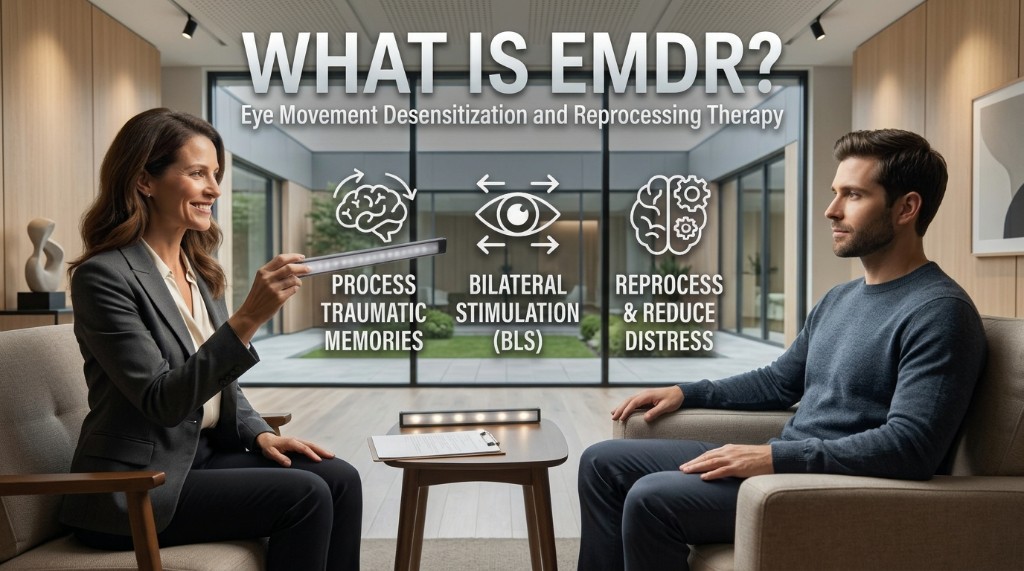
The part people are most curious about is the bilateral stimulation. In practice this can be side-to-side eye movements following your therapist’s fingers or a light bar, alternating taps, or alternating tones.
Each set lasts roughly 30 seconds. Between sets your therapist asks you simply to notice what came up. People commonly report the image shifting, the feeling changing, or a new thought arriving unprompted.
Two simple scales track progress. The SUD scale, for Subjective Units of Disturbance, runs from 0 to 10 and measures how distressing the memory feels in the current moment. The VOC scale, for Validity of Cognition, runs from 1 to 7 and measures how true the preferred positive belief feels in the current moment.
EMDR is not hypnosis. You stay fully awake and aware, you remember everything, and you can pause or stop at any time. You’re in control from start to finish.
Healing often continues between sessions. You might notice new memories or emotions surfacing during the week. This is a sign your brain is still doing the work. Your therapist will prepare you for this ahead of time, so you’ll know what to expect and how to take care of yourself.
Who Can EMDR Help?
EMDR is best known as a treatment for PTSD, but it’s also used for anxiety, panic, phobias, grief, and painful experiences that don’t meet the definition of “trauma” but still affect you today. You don’t need a PTSD diagnosis to benefit.
How Long Does It Take?
The number of sessions depends on what you’re working on. A single distressing event may resolve in a few sessions. Experiences that were long-term or started in childhood usually take longer, and more time is often spent in the preparation phase first. Your therapist will talk through a realistic timeline with you at the start.
Is EMDR Right for You?
If you’ve been carrying a memory that still feels too close, too painful, even after talking about it, EMDR may be worth exploring. The best way to find out is a conversation. Book a session with one of our therapists at Mediverse Health, and together you can decide whether EMDR is the right fit for where you are now.
To learn more or request an appointment, call (888) 632-1240 or visit mediverse.health to reach our psychotherapy team in Oak Brook.
About the author
Our editorial bench pairs board-certified clinicians with operations leaders.
Frequently asked questions
- Is EMDR the same as hypnosis?
No. During EMDR you stay fully awake and aware, you remember everything, and you can pause or stop at any time.
- Who can EMDR help?
EMDR is best known for PTSD, and it is also used for anxiety, panic, phobias, grief, and painful experiences that still affect you even without a PTSD diagnosis.
- How long does EMDR take?
A single distressing event may resolve in a few sessions. Long-term or childhood experiences usually take longer, with more time often spent in preparation first.
- What is bilateral stimulation in EMDR?
It can be side-to-side eye movements with fingers or a light bar, alternating taps, or alternating tones, usually in short sets of about 30 seconds.
Take the next step with Mediverse
Trusted clinical leadership in Oak Brook and telehealth statewide — built for outcomes, access, and continuity.
Partner with Mediverse
Staffing, telehealth coverage, and operational partnerships.
Talk with partnerships