
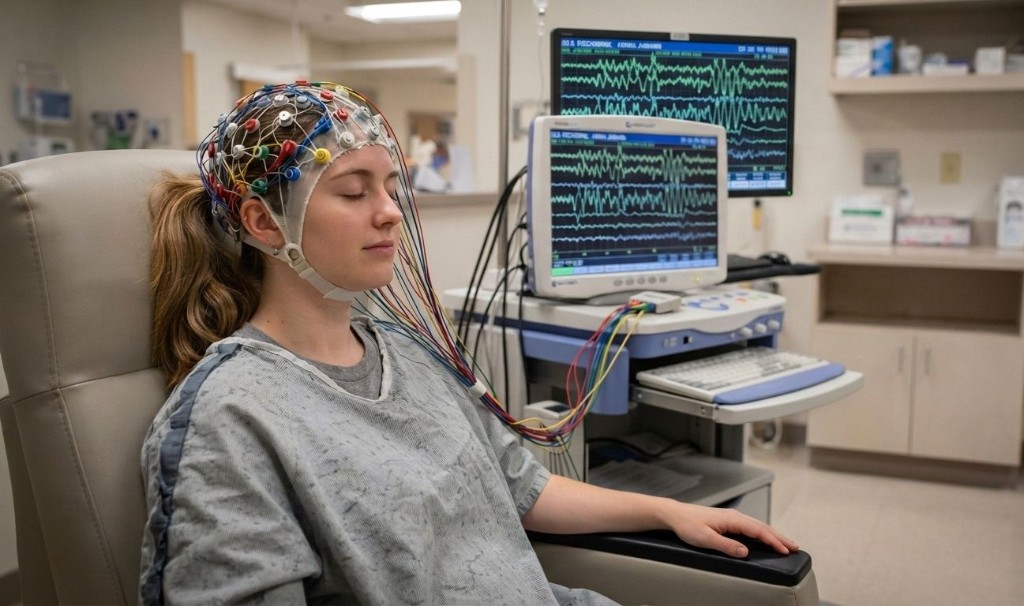
Your doctor mentioned an EEG. Maybe you have already looked it up, maybe you have not. Either way, it is completely reasonable to have questions about a test that involves your brain. Here is a clear walkthrough of what an EEG is, why it is a useful tool for your care team, and what the experience looks like from check in to checkout.
What Does an EEG Measure?
EEG stands for electroencephalogram. It is a test that records electrical activity in your brain using small sensors called electrodes. These electrodes sit on your scalp and pick up the natural electrical signals your brain produces throughout the day. They do not send any electricity into your body. They only listen and record.
The recorded signals appear as wave patterns on a screen. A board certified neurologist reviews those patterns to understand how different areas of your brain are working. The test gives your care team a detailed look at brain activity that other types of imaging cannot capture on their own.
The entire process is painless. There are no needles, no radiation, and no sedation for a routine EEG. Most patients say the hardest part is simply sitting still for a bit.
Why Would Your Doctor Recommend an EEG?
There are many reasons a physician might suggest brain wave testing. An EEG provides valuable information that helps your care team build a complete picture of your neurological health. Your doctor might recommend one to better understand recurring seizures, fainting, shaking, tremors, memory loss, confusion, and dementia; to look into episodes of dizziness or lightheadedness; to evaluate changes in your sleep patterns; to follow up after a previous neurological evaluation; or to gather baseline information about how your brain is functioning overall.
An EEG is one of the most widely used tools in neurology because it captures real time data about brain activity. Unlike imaging tests that show structure, an EEG shows function. That makes it uniquely helpful when your doctor wants to understand what is happening in your brain moment to moment.
If you have been referred for an EEG, it typically means your doctor is being thorough and wants the best possible information before recommending next steps. That is a good thing.
How to Prepare for Your EEG Appointment
Getting ready is straightforward:
- Wash your hair the night before and skip the conditioner, gel, hairspray, or any other styling products. Clean hair helps the electrodes make a strong connection to your scalp, and better contact means a clearer recording for your neurologist to review.
- Eat a normal meal before your appointment. Stable blood sugar supports a more accurate recording, so arriving well fed is actually recommended.
- Continue taking your regular medications as usual unless your doctor gives you specific instructions to do otherwise.
If your doctor has ordered a sleep deprived EEG, you will be asked to adjust your sleep schedule the night before. Certain brain wave patterns are easier to capture when you are naturally drowsy, so your doctor may ask you to stay up a bit later or wake up earlier. The office will walk you through the specific instructions when you schedule your appointment.
Comfortable clothing is a good idea since you will be sitting or reclining for the duration of the test. Something loose fitting helps you relax.
What Happens During the Test
When you arrive, a trained EEG technologist will bring you to a quiet, comfortable room and explain the entire process before anything begins. You will sit in a reclining chair or lie down on a bed. The technologist will measure your head and gently mark specific spots where each electrode will be placed. Each electrode is attached using a water soluble paste that comes out easily in the shower afterward.
Once everything is connected and the recording starts, a routine EEG typically takes about 20 to 40 minutes of actual recording time. The full visit, including setup and cleanup, usually runs about 60 to 90 minutes.
During the recording, you will be asked to relax with your eyes closed for portions of the test. The technologist may ask you to take a few deep breaths or look briefly at a gently flashing light. These are standard techniques used in EEG testing that help your neurologist see how your brain responds to mild stimulation. You may also be encouraged to rest or doze off, since brain wave patterns during sleep provide your care team with additional useful data.
You will not feel anything from the electrodes during the recording. When the test is complete, the technologist removes everything and helps clean the paste from your scalp. You can drive yourself home and go about your normal routine right away.
Types of EEG Tests
Depending on what information your doctor needs, there are a few formats the test can take. Your neurologist will recommend the one that fits your situation best.
Routine EEG
A routine EEG is the most common type. It is performed in a clinic, takes about an hour total, and captures brain wave activity while you are awake and possibly drowsy. This is the starting point for most patients and provides a strong foundation of data for your care team.
Ambulatory EEG
An ambulatory EEG uses a small, portable recording device that you wear for one to three days while going about your normal daily life. This extended monitoring captures brain activity across a wider range of situations, including your natural sleep cycle. It is a great option when your neurologist wants a longer window of data without requiring you to stay in a clinic.
Video EEG
A video EEG combines continuous brain wave monitoring with video recording. This is typically done in a dedicated monitoring unit and allows your care team to match brain wave patterns with what is happening in real time. It provides the most detailed picture available and is useful when your neurologist wants the fullest possible view of your brain’s activity.
Understanding Your Results
EEG results are not available on the spot. After your test, a board certified neurologist reviews the entire recording carefully, examining wave patterns, timing, symmetry, and activity across different regions of the brain. This analysis takes time because the neurologist is reading through the full recording with precision.
Once the review is complete, the findings are sent to the doctor who ordered your test. Your doctor will then schedule a follow up conversation to walk you through the results and explain what they mean for your next steps.
The information from an EEG helps your care team move forward with confidence. It gives them objective data to guide your personalized care plan, whether that means confirming that your brain activity looks healthy or identifying a clear direction for your ongoing care. Either way, the data is always valuable.
Does Insurance Cover an EEG?
Most major insurance plans cover EEG testing when it is ordered by a physician. Coverage details and out of pocket costs vary depending on your specific plan, your deductible, and whether the facility is in network. At Mediverse Health, our team can help verify your insurance benefits and give you a clear picture of what to expect before your appointment.
If you have questions about coverage, call our office and we will look into it for you before you come in.
Schedule Your EEG in Oak Brook
If your doctor has recommended an EEG, or if you have been wondering whether brain wave testing might be a helpful next step, our neurology team is here for you. Mediverse Health offers EEG testing at our Oak Brook clinic with results reviewed by a board certified neurologist. Most patients are seen within two weeks of reaching out.
To schedule your EEG or to speak with our neurology team, call (888) 632 1240 or visit mediverse.health to request an appointment online.
About the author
Dr. Usman Qadeer focuses on.
Frequently asked questions
- Is an EEG painful?
No. A routine EEG is painless. Electrodes only record your brain's natural electrical activity. There are no needles, no radiation, and no sedation for a standard test.
- How long does an EEG take?
Recording usually lasts about 20 to 40 minutes. Including setup and cleanup, most visits take about 60 to 90 minutes.
- Can I drive after my EEG?
Yes. After a routine EEG you can drive yourself home and return to your normal activities right away.
- Does insurance cover EEG testing?
Most major plans cover EEG testing when ordered by a physician. Coverage and out-of-pocket costs vary by plan. Our team can help verify your benefits before your visit.
Related insights
 Lab Tests
Understanding Lab Panels: What Your Results Really Mean
Decode common biomarkers without drowning in jargonùand know when to escalate.
Take the next step with Mediverse
Trusted clinical leadership in Oak Brook and telehealth statewide — built for outcomes, access, and continuity.
Partner with Mediverse
Staffing, telehealth coverage, and operational partnerships.
Talk with partnerships